
Three Hard Truths About AI Application
Picture a CEO across the table from you. He runs a 70-person services business, the kind that does three Christmas parties a year and gets the dispatcher a leather chair every five years. He just signed a check for $40,000 in Microsoft Copilot seats. You ask him how it’s going. He leans back and says “great. Team’s all in.”
Then you walk the floor.
The receptionist is using ChatGPT Free on her phone because nobody put her on the seat list. The dispatcher built a routing prompt in Claude, off the books, because IT blocked ChatGPT in March. The CFO has touched AI exactly once, to write a birthday card. And the new estimator, the one quietly outperforming the rest of the team, has been running every customer email through GPT-4 since January and hasn’t told anyone.
The CEO told you “we’re all in.” He’s right. He just doesn’t know what “in” means.
That gap, between what the corner office sees and what’s actually happening at the desks, is most of what’s actually happening with AI in 2026. It’s the story Axios HQ just published in its 2026 State of Workplace Communication report, surveying 475 leaders and 814 knowledge workers in March and April. It’s also the story we keep watching play out in 30-person HVAC companies, 60-person property managers, and 90-person manufacturing reps across Virginia.
The headline: roughly a third of the orgs Axios surveyed grew on 7+ of 12 markers like revenue, retention, engagement, the things that actually count. Between those high performers and the bottom of the pack there’s a 40-percentage-point growth gap, about 10 points wider than last year. The two things that close it aren’t strategy decks or new logos. They’re communication tools and training.
A few other things in that report should make you put your coffee down:
- Missed deadlines doubled year over year. Same companies, same people. Just twice as many things slipping.
- $51,790 in salary waste, per year, per $200K+ earner, attributable to bad communication. That’s a senior person’s full second mortgage paid out the window.
- 71% of leaders say their AI policies are in place. The #1 blocker employees report is “no clear policies.” Both can’t be true. One side is lying to itself.
- AI ownership is split across eight different stakeholders. No consensus owner. Translation: nobody owns it, which means nobody’s accountable for it.
Inside that report sit three hard truths any operator running a 25-to-500 person company should read before the next renewal. Here they are.
Hard truth #1: your read on your team’s AI use is wrong
Back to that 60-person services firm. The CEO is in front of his board on a Wednesday. They ask about AI adoption. He says “25% of our team are power users.” He believes it. He’s seen people use it. He’s signed the seat invoice.
You spend Tuesday in the same building. You ask the same question to the team. The actual number of people who could pull up an AI tool right now and walk you through three workflows they use it for is four. Out of 60. Six and a half percent.
The CEO isn’t lying. He’s just looking at the wrong thing. He’s seeing surface signal, the meeting where someone says “I had ChatGPT draft this,” and rounding the whole team up to that bar.
Axios HQ 2026 found leaders self-report that 19% of employees are AI power users. Employees say 9%. Leaders say only 3% of their team rarely or never use AI. Employees say 29%.
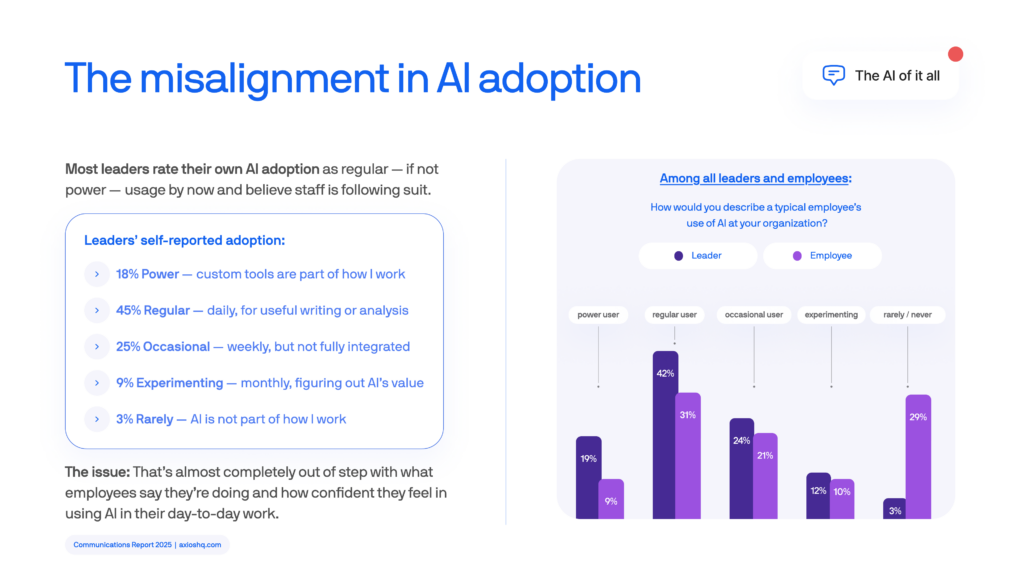
Leaders are off by roughly 2x on the top end and roughly 10x on the bottom end. The team’s middle, the broad base of people who tinker but don’t operate, is invisible from the C-suite.
It gets worse when you add the shadow data. Microsoft and LinkedIn’s 2024 Work Trend Index found 80% of AI users bring their own AI tools to work, with the share running higher at small and mid-sized companies. Personal accounts. Personal phones. Off the corporate stack. 52% of users said they were reluctant to admit AI use on important tasks. Slack’s Workforce Index, Fall 2024, put it bluntly: nearly half of US workers feel uncomfortable telling their manager they used AI. They’re afraid of looking incompetent. They’re afraid of looking like they cheated.
So the CEO’s read is wrong in two directions at once. He’s overcounting the people who look like power users in meetings, and undercounting the dispatcher running a routing prompt in a tab nobody asked about.
McKinsey’s research has leaders under-estimating daily AI use. Leaders guessed 4%; the actual was 13%. Axios has leaders over-estimating power-user prevalence. Both are real. The pattern under both is the same. Leaders are bad at calibrating depth. They see a thing happening and round up to “we’re doing this.” The team knows the difference between “we have seats” and “this is in my Tuesday.”
If you ran the same survey in your building this Monday, what would the gap be? Most operators we’ve talked to don’t want to find out. The ones who run it anyway always discover the same two things: the official “AI champion” isn’t the most prolific user, and there’s a quiet middle-tier person who’s already redesigned half their job around the tools. Nobody told the boss.
Hard truth #2: training is the moat. The tools aren’t.
Two 80-person companies. Same industry. Same year. Same revenue band.
Company A spent $30,000 on AI tools last year. Copilot, ChatGPT Enterprise, the works. Company B spent the same $30,000 on tools and another $15,000 on training, a structured rollout with weekly office hours, prompt libraries, and one ops lead who owned it.
Eighteen months later, Company A grew 3%. Company B grew 11%. The line items look almost identical on the P&L. The result is night and day. Walk Company A’s floor and people use AI like a faster Google. Walk Company B’s floor and people use it like a junior analyst, drafting the SOW, pulling the comp set, prepping the client review.
That’s the arc Axios HQ 2026 documents.
High performers are 3 to 5x more likely to be confident in their training strategy. 52% of high performers significantly increased structured communication training in the last 18 months. Only 9% of low performers did. On AI tools and employee enablement, the split is 55% versus 18%.
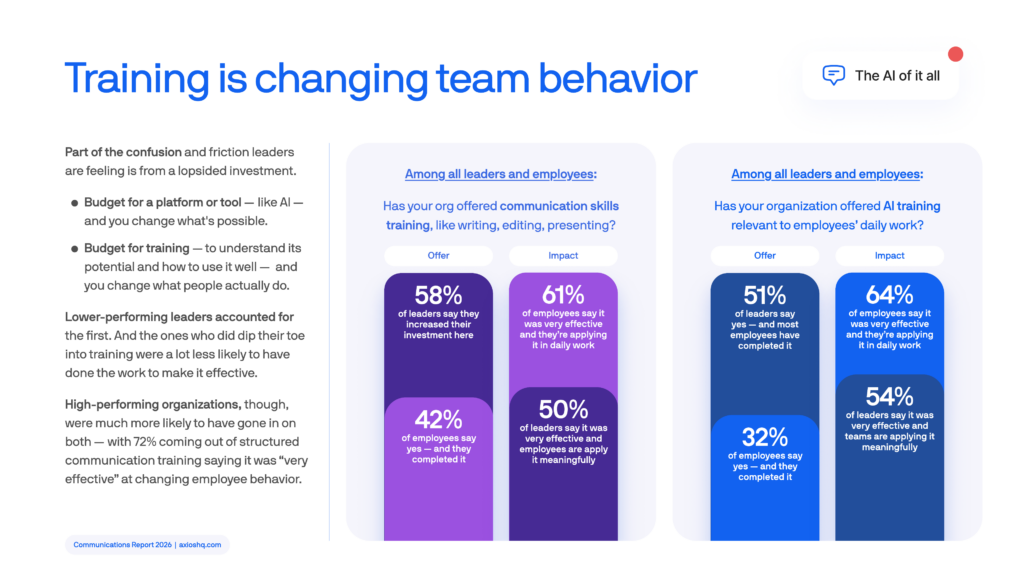
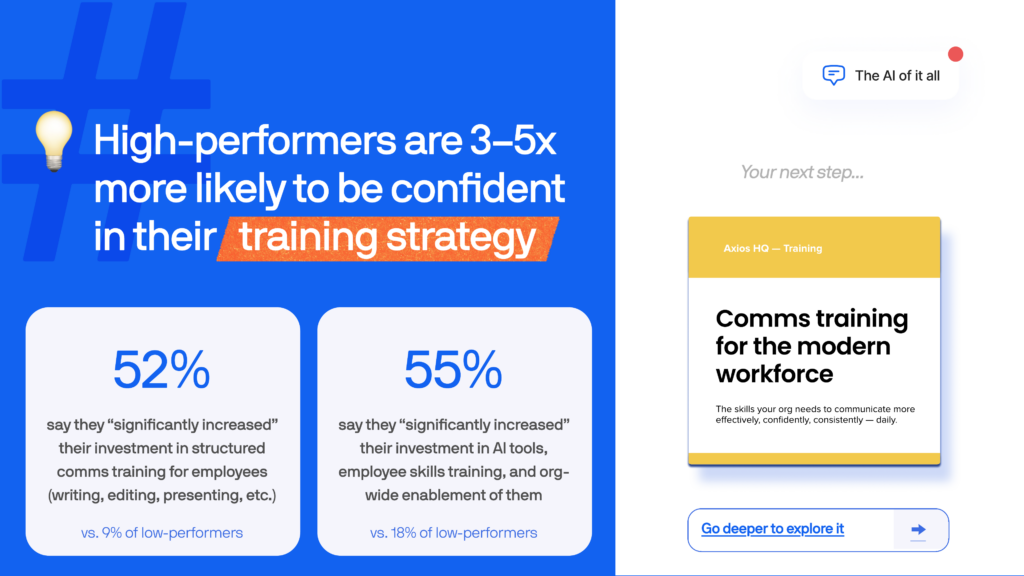
This is the single most consistent finding in the entire AI productivity literature, and the third-party data lines up across the field.
Slack’s Workforce Index, Fall 2024: workers trained on AI are up to 19x more likely to report AI improving their productivity. 30% of workers got zero training, including no self-directed learning. That’s the biggest number we have, and it’s mostly being ignored.
BCG’s AI at Work 2025 study: 79% of employees with 5+ hours of training are regular AI users, versus 67% with less. Five hours of structured exposure moves people from dabbling to regular use. Not a certification. Not a week-long off-site. Five hours.
Brynjolfsson, Li, and Raymond’s Stanford/NBER study (2023, peer-reviewed in QJE 2025) tracked roughly 5,000 customer support agents at a Fortune 500 enterprise software company serving small businesses. AI lifted productivity 15% on average. Less-experienced workers gained 30%+. Top performers gained almost nothing. The kicker buried in the appendix: workers kept improving even on days the AI was offline, but only the ones who’d had structured exposure. The training built the judgment. The tool just exposed it.
Ethan Mollick, in Co-Intelligence (Wharton, 2024), put it in one sentence: “Only by trying AI out with tasks do you develop a feel for when AI would be helpful and when you might push back.” That feel is what training builds. The AI itself doesn’t.
On the SMB ground specifically, Goldman Sachs’ 10,000 Small Businesses Voices report (Feb 2026) found 76% of small businesses report using AI. Only 14% have fully integrated it into core operations. 73% say more training would help. The gap between “we use AI” and “AI is in our workflow” is the entire ballgame, and it’s a training gap.
A ChatGPT Enterprise subscription is a line item. Training is what makes the line item earn its keep. We’ve watched too many SMB operators sign the seat invoice, skip the rollout, and then conclude six months later that “AI didn’t really do much for us.” The AI didn’t do much. They didn’t do much with the AI.
Hard truth #3: AI amplifies whatever dysfunction you already have
A 25-person property management company in Henrico. The ops lead, sharp, overworked, the kind of person who actually replies to emails, figures out in February that ChatGPT can draft her Monday “weekly status update” in two minutes instead of 45. Great win. She earns the time back.
By April, the update is 1,200 words long, because why not, the AI’ll write it.
By May, none of the four people on her team are opening it.
Volume up. Clarity down. AI made the email cheaper to send. Nobody stopped to ask whether anyone needed it in the first place.
This is the third hard truth, and it’s the one that sneaks up on operators. Axios HQ 2026 found 30% of leaders say internal communication volume is going up. The same leaders say organization-wide clarity is going down.
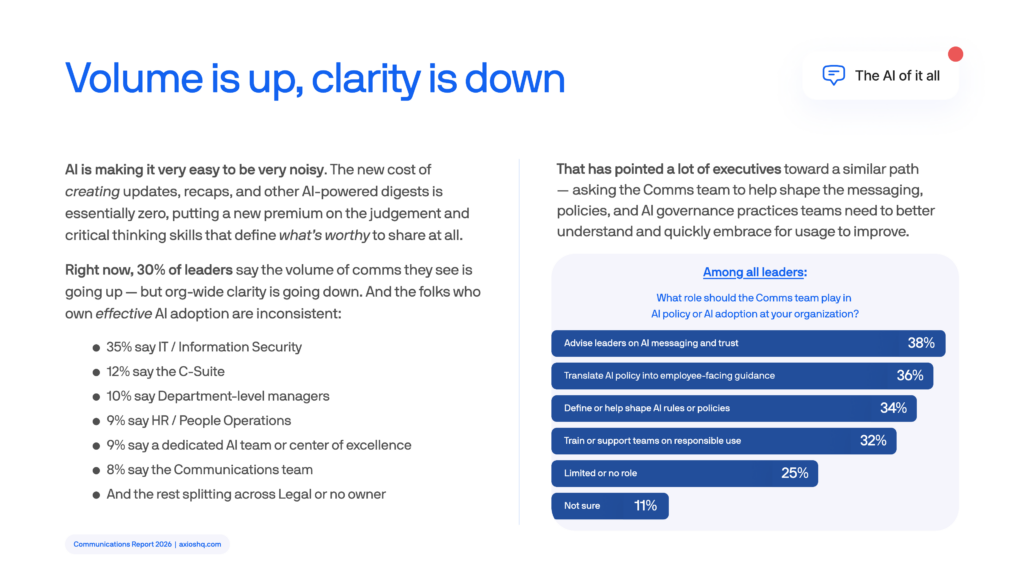
Axios calls it amplification: AI makes whatever’s already true about a team more true. Weak judgment plus inconsistent communication plus more volume equals more confusion, not less.
Microsoft’s 2025 Work Trend Index, “Breaking Down the Infinite Workday,” found employees are interrupted every 2 minutes during core work hours. 275 interruptions a day. 58 chats sent outside work hours daily. After-8PM meetings up 16% year over year. 48% of employees and 52% of leaders say work feels “chaotic and fragmented.”
Asana’s “The Way We Work Isn’t Working” 2025 report: knowledge workers spend roughly 60% of their time on “work about work.” Chasing updates, switching tools, around 25 app switches per day across 10 apps.
The headline study is the one operators should pin to the wall. Dell’Acqua, Mollick, and the HBS/BCG “Jagged Frontier” team randomized 758 BCG consultants in 2023. On tasks inside AI’s frontier, AI users finished 25% faster and the work scored 40% higher on quality. On tasks outside AI’s frontier, the ones that look similar but require different judgment, the AI users got it right 60-70% of the time. The control group, no AI, got it right 84%.
That’s peer-reviewed proof that AI, applied without judgment, makes work worse. Not slower. Worse.
So you have a workforce already drowning in interruptions, spending 60% of its time on the meta-work of keeping track of work, given a tool that can produce content at five times the volume with no marginal cost. Of course the email got to 1,200 words. Of course nobody’s reading it.
The judgment to know what’s worth saying just got more valuable, not less. The bottleneck used to be production. Now it’s selection: what’s worth writing in the first place. Most companies have not promoted anyone to handle the new bottleneck.
We don’t know what we don’t know
What the CEO across the table doesn’t know yet, and probably can’t:
AI adoption is still in its infancy. We don’t know what we don’t know. And what we don’t know is changing almost as fast as we can learn it.
Mollick calls the boundary the “jagged frontier.” Capability cliffs that are invisible until you walk into them. The AI can do things you assumed it couldn’t, and can’t do things you assumed it could, and the line between the two moves every six weeks. Every operator we know who’s been honest with themselves has a story about the workflow they were sure AI would handle and didn’t, right next to the workflow they were sure it wouldn’t and did.
The macro numbers tell you the same thing. 96% of US small businesses plan to adopt AI (US Chamber of Commerce, 2025). 14% have fully integrated it into core operations (Goldman Sachs, Feb 2026). The gap between those two numbers, between intention and integration, is mostly a ChatGPT subscription nobody’s measuring, on a credit card nobody’s tracking, used by people the boss thinks are using it more than they are and the team thinks are using it less than they should be.
The companies that come out the other side of the next 18 months in better shape than they went in won’t be the ones with the most seats. They’ll be the ones running short, honest experiments. Picking one workflow. Measuring before. Training the team. Measuring after. Killing it if it didn’t work. Doubling down if it did.
The leaders who do well in the next two years will be the ones who can say “I don’t know yet” without flinching. There’s no playbook to copy. There’s only the one your team writes by trying things, in your building, with your people, on your numbers.