
Clearwater Infrastructure Group
How a 22-person water infrastructure firm replaced 9 disconnected tools with one unified platform — and saved $93K in the first year.
Executive Summary
Clearwater Infrastructure Group is a mid-Atlantic water infrastructure engineering and design firm with 22 employees. They handle municipal water system design, stormwater management, environmental compliance, and construction oversight for local governments and utilities — billing roughly $4.2 million annually across a dozen active projects at any given time.
Like most firms their size, Clearwater had grown into a patchwork of disconnected tools: a CRM for government contract tracking, a separate project management platform, standalone time tracking, document storage in one place, compliance tracking in another, and a legacy database someone built in Microsoft Access back in 2014 that nobody wanted to touch but everyone depended on.
Ironworks AI consolidated Clearwater’s operations into a single custom platform — “Clearwater Hub” — that replaced seven of their nine tools, eliminated 28 hours per week of administrative overhead across the firm, and delivered an estimated $92,800 in annual ROI through direct cost savings and labor efficiency gains.
The Challenge
Clearwater wasn’t failing. They were winning work, delivering projects, and growing steadily. But growth was making their operational duct tape harder to hold together.
The firm was running across nine disconnected tools:
Salesforce Essentials
RFP tracking & government contracts
$1,650/moMonday.com
Project management
$440/moQuickBooks Online
Invoicing & accounting
$90/moDropbox Business
Document storage (plans, permits, reports)
$440/moClockify Pro
Time tracking & billing hours
$264/moDocuSign
Contract execution
$45/moMicrosoft Teams
Internal communication
$132/moShared Spreadsheets
Compliance tracking, inspections, certifications
$0 (enormous time cost)Legacy Access DB
Municipal permit tracking
$0 (irreplaceable)Project managers spent roughly 6 hours per week reconciling time entries in Clockify with project budgets in Monday.com — because the two systems didn’t talk to each other.
There was no single view of project profitability. Finance had to manually cross-reference QuickBooks invoices with Monday.com project data and Clockify hours to figure out which projects were making money and which were bleeding it.
RFP responses were assembled from scratch every time. Pulling together past project data, team qualifications, PE certifications, and relevant experience from across Salesforce, Dropbox, and personal files took 12+ hours per proposal.
Field inspectors used paper forms. Site visit data was recorded on printed checklists, then entered manually into the system back at the office — often days later. Photos lived in camera rolls, unlinked to project records.
Client reporting was a monthly PowerPoint exercise. Someone spent a full day each month building status presentations by pulling data from four different systems into slides.
Compliance deadlines lived in a shared spreadsheet that had already caused one missed permit renewal and two close calls on PE license expirations.
When you added up the labor waste — the re-keying, the reconciling, the manual report building, the context switching between nine different interfaces — Clearwater’s team was losing roughly 42 hours per week to work that shouldn’t have required a human at all.
The Ironworks Approach
Consult 2 Weeks
Ironworks started with a full operational audit. We shadowed project managers, sat with field inspectors, watched the finance team assemble their monthly reports, and mapped every handoff point between systems.
The findings were clear: Clearwater had 23 distinct manual handoff points between their tools, 4 places where the same data was being entered into multiple systems, and zero automation connecting any of it.
We quantified the waste: approximately 42 hours per week across the firm — the equivalent of one full-time employee doing nothing but moving data between systems.
The recommendation: consolidate everything except QuickBooks (needed for tax accounting) and Teams (already embedded in daily communication) into a single, purpose-built platform.
Build 10 Weeks
Over 10 weeks, Ironworks designed and built "Clearwater Hub" — a unified web application built specifically for how Clearwater operates. The platform replaced seven tools with one, connected to QuickBooks and Teams via API integrations, and introduced AI-assisted capabilities for RFP responses and project risk detection.
Every two weeks, the Clearwater team saw working software, gave feedback, and watched their workflows come to life in a system built around their processes — not the other way around.
Manage Ongoing
After launch, Ironworks transitioned to an ongoing managed services engagement. This includes platform hosting, monitoring, and maintenance; monthly feature additions based on team feedback; AI model tuning as more project data flows through the system; and quarterly business reviews to identify new automation opportunities.
The Solution — Clearwater Hub
A single platform built for how Clearwater actually works — from bidding on projects through final closeout.
Unified Project Dashboard
Every project from bid to closeout in one view. Timeline, budget versus actual, team assignments, document library, inspection schedule, and client communication log — all in a single interface. No more toggling between Monday.com for tasks, Clockify for hours, and Dropbox for files.
Smart Time Tracking & Billing
Engineers log time directly against project phases. The system auto-calculates billable amounts based on contract rates, generates draft invoices, and syncs everything to QuickBooks for accounting. What used to take 6 hours of weekly reconciliation now happens automatically.
RFP Response Engine
An AI-assisted proposal builder that pulls firm qualifications, past project data, team resumes, and compliance certifications into RFP response templates. Instead of assembling every proposal from scratch, the system suggests relevant project experience and drafts response language. Proposal prep dropped from 12+ hours to approximately 3 hours.
Mobile Field Inspection App
A mobile-optimized interface that lets inspectors log site visits, complete inspection checklists, upload photos, flag issues, and generate reports — all from their phone, all flowing directly into the project record. No paper forms, no delayed data entry, no orphaned photos.
Compliance & Certification Tracker
Automated tracking and alerts for everything with a deadline: permit renewals, PE license expirations, insurance certificates, regulatory submissions. The system sends escalating reminders starting 90 days before expiration. No more spreadsheet tracking, no more close calls.
Client Portal
An external-facing portal where Clearwater's clients — municipalities, utilities, developers — can log in to see real-time project status, review inspection reports, download documents, and approve milestones. Replaced the manual monthly PowerPoint deck with an always-current view.
AI-Powered Project Insights
The system continuously monitors project health data and flags issues before they become problems: projects trending over budget, timeline risk based on historical patterns, resource conflicts, and upcoming capacity constraints. Project managers get proactive alerts instead of discovering problems in monthly reviews.
See It In Action
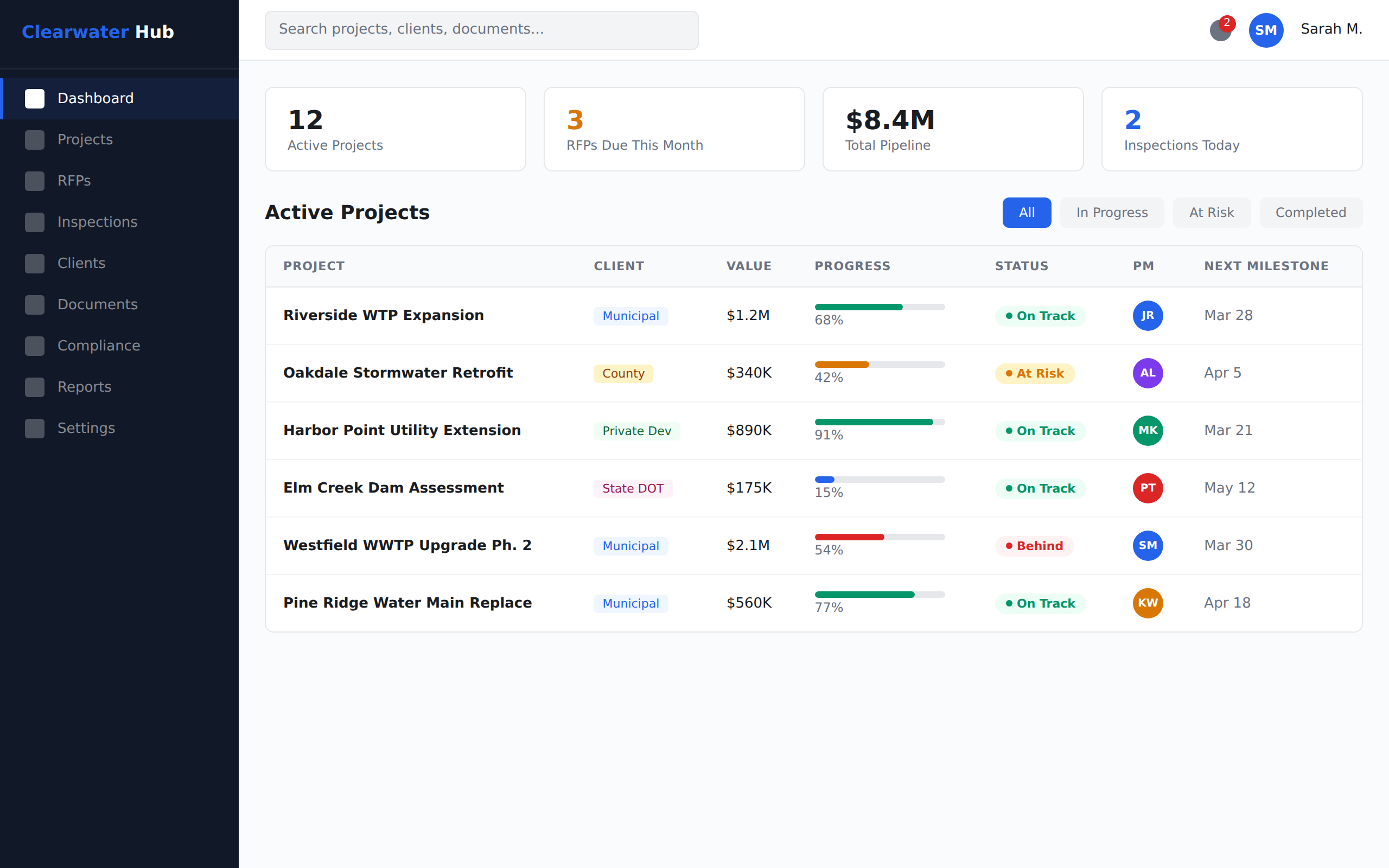
Project Dashboard
The nerve center. Every active project at a glance — status, budget health, team assignments, and upcoming milestones. Project managers start their day here instead of checking three different tools. The status indicators are calculated automatically from budget burn rate, timeline progress, and open issues.
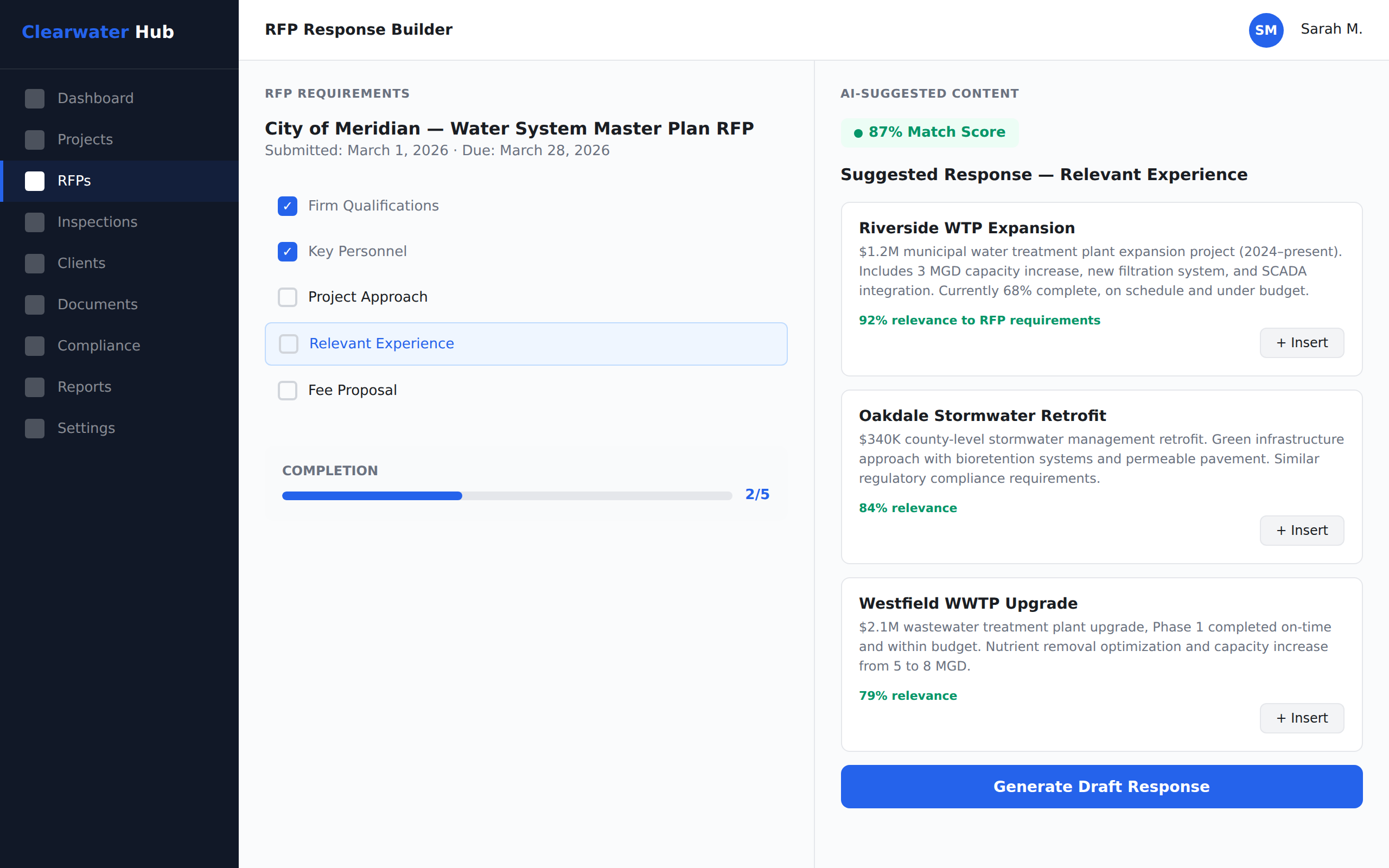
RFP Response Builder
Proposals in hours, not days. The left panel shows parsed RFP requirements; the right panel surfaces AI-suggested content from Clearwater's project history. The system identifies relevant past projects, pulls qualification data, and drafts response sections that the team reviews and refines.
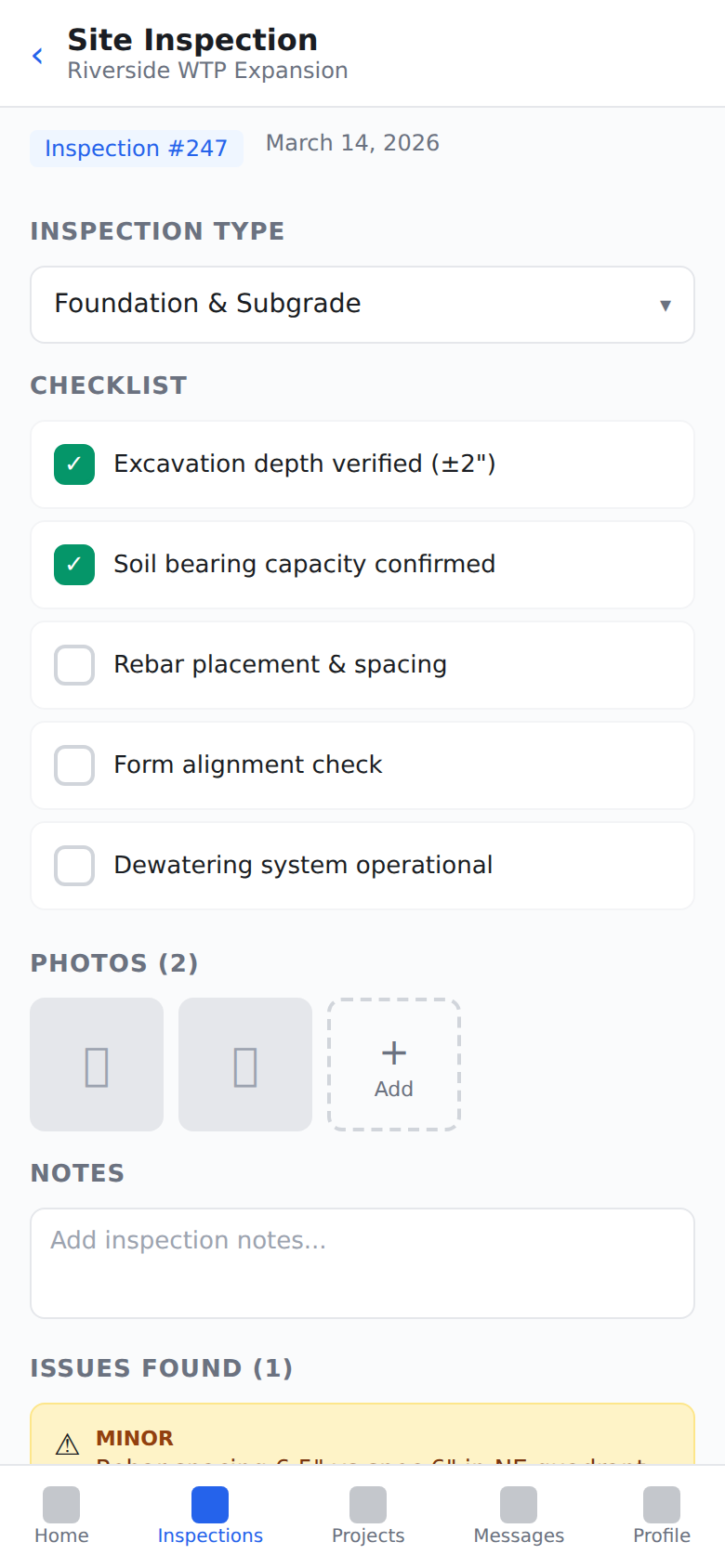
Mobile Inspection App
Field data that doesn't wait. Inspectors complete checklists, snap photos, flag issues, and file reports from the job site. Everything flows into the project record immediately — no paper forms, no end-of-day data entry. Issues flagged in the field trigger instant notifications to the project manager.
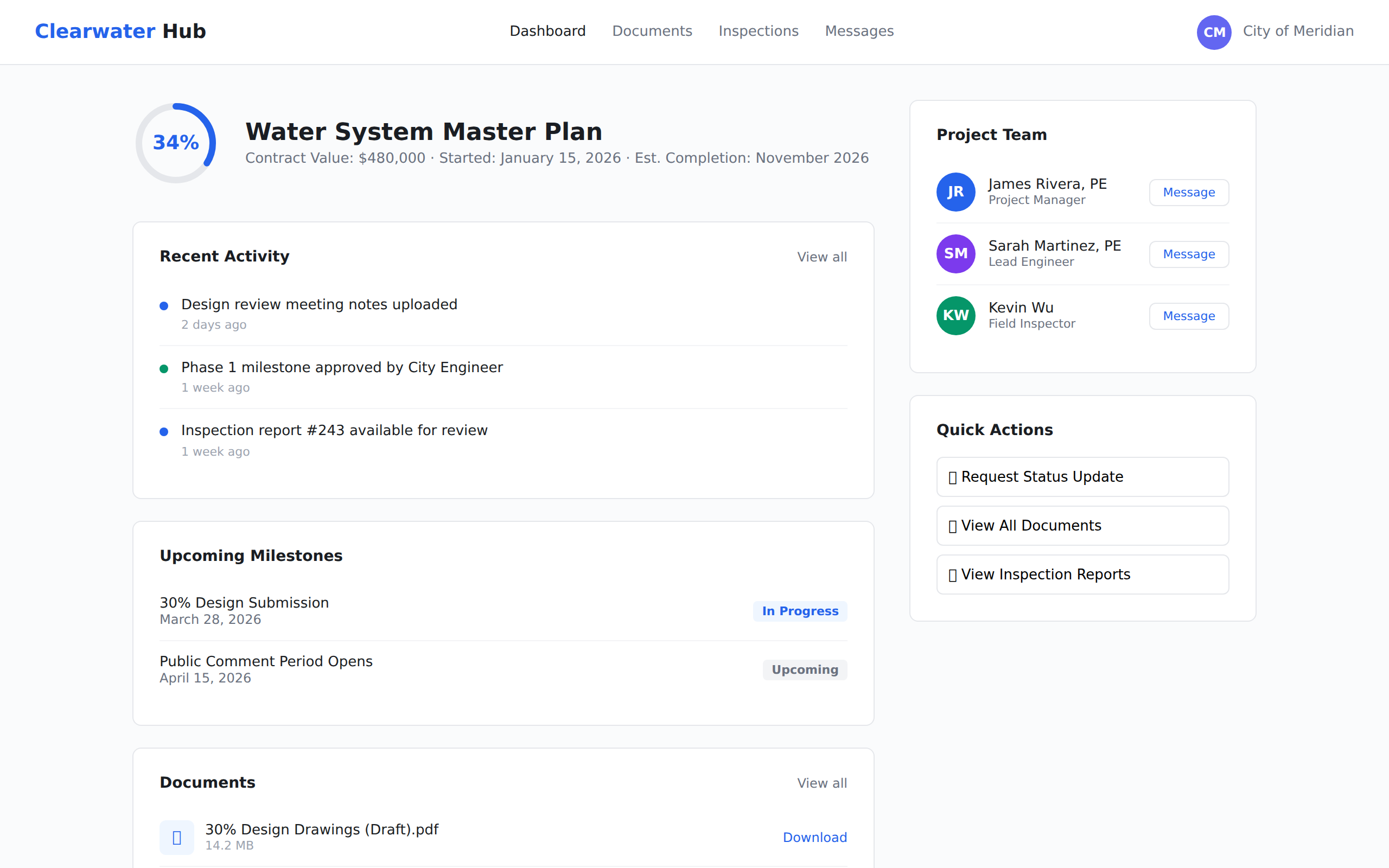
Client Portal
Your clients see what you see — when they need to. Municipal clients log in to track project progress, review inspection reports, download documents, and approve milestones. This replaced a manual monthly reporting process and gives clients confidence in project status between formal update meetings.
Results & ROI
| Metric | Before | After | Impact |
|---|---|---|---|
| Weekly admin overhead (firm-wide) | 42 hours | 14 hours | 67% reduction — 28 hours reclaimed |
| Monthly SaaS spend | $3,061 | ~$890 | 71% reduction — $2,171/mo saved |
| RFP preparation time | 12+ hours each | ~3 hours each | 75% faster turnaround |
| Invoice generation | 3 days/month process | Same-day automated | 90% time reduction |
| Missed compliance deadlines | 1-2 per year | 0 | Eliminated |
| Client reporting | Manual monthly | Real-time portal | Always current |
| Data entry duplication | 4 redundant entry points | 0 | Eliminated |
| Annual direct SaaS savings | — | $26,052/year | License cost reduction |
| Annual labor efficiency value | — | ~$66,768/year | 28 hrs/wk × $46/hr × 52 wks |
| Estimated total annual ROI | — | ~$92,820/year | Combined savings + efficiency |
Labor efficiency calculated at Clearwater's average blended admin rate. Actual value may be higher when considering opportunity cost of senior engineers performing administrative tasks.