
The Handloom Weaver Was the Call-Center Rep of 1820
The Virginia Chamber Foundation dropped a 127-page report in January saying 35% of all Virginia jobs face AI exposure. Up to 1.5 million jobs affected. 481,000 of them early-career. Northern Virginia’s North Arlington County now ranks third nationally for AI exposure, and Richmond isn’t far behind — Axios reported that 240,000 jobs in the Richmond region (34.3% of the local total) are exposed, and 77,300 of those are young-worker jobs.
The headline writes itself. Virginia is on fire. AI is coming for your kid’s first job.
We’re not going to tell you that’s wrong. The entry-level squeeze is real, and we’ll get to the data on it in a minute. What we are going to tell you, as a Virginia firm that helps small and mid-sized businesses figure out where AI fits and where it doesn’t, is that the framing is wrong. Every general-purpose technology of the last 250 years arrived with the same forecast. Every single one. And the aggregate result, every single time, was higher output, higher wages, and more jobs in categories nobody had a name for yet.
Call it pattern recognition. So before a 30-person HVAC shop in Mechanicsville freezes hiring because some Brookings panel said the sky is falling, let’s go through what’s actually happening, what’s actually different, and what an SMB operator in the mid-Atlantic should actually do about it.
The honest pressure point: entry-level is real
We’re not dodging the bad news. In August 2025, Stanford’s Digital Economy Lab, led by Erik Brynjolfsson and two co-authors, pulled ADP payroll microdata covering millions of workers across tens of thousands of firms. The finding: a 13% relative employment decline for early-career workers ages 22-25 in the most AI-exposed occupations since late 2022. Software engineering, marketing, customer service. Meanwhile workers age 30 and up in those exact same occupations saw employment grow 6 to 12% over the same window.
That’s the cleanest evidence anyone has produced that AI is shifting hiring at the bottom of the knowledge-work ladder. Goldman Sachs estimates it’s costing roughly 16,000 US jobs per month, concentrated in Gen Z. The DC corridor data shows tech postings for financial managers and data scientists down 45% to 54% between 2022 and 2025.
Daron Acemoglu at MIT — the loudest credentialed skeptic of AI productivity hype — projects a “modest” 0.66% productivity gain over ten years and pegs his realistic estimate below 0.53%. He thinks the bull case is silly. He’s a serious economist and he might be right.
So: junior knowledge work is getting compressed. Productivity gains might come slow. Both can be true. The question is whether that means SMBs should panic or whether it means SMBs should pay attention to a 250-year-old pattern that keeps repeating.
Every tech loop got this same forecast
Here’s the part nobody wants to do, because it requires sitting with history for a few minutes instead of reading the next breathless take. Steam, rail, electricity, mass production, computing, the internet — every one of these arrived with credentialed economists, journalists, and elected officials predicting the end of broad employment. Every one of them produced higher wages within a generation. Every one of them produced new jobs the doomsayers couldn’t have named because the categories didn’t exist yet.
The pattern is so consistent it’s almost boring. Let’s walk it.
Steam, looms, and Engels’ pause
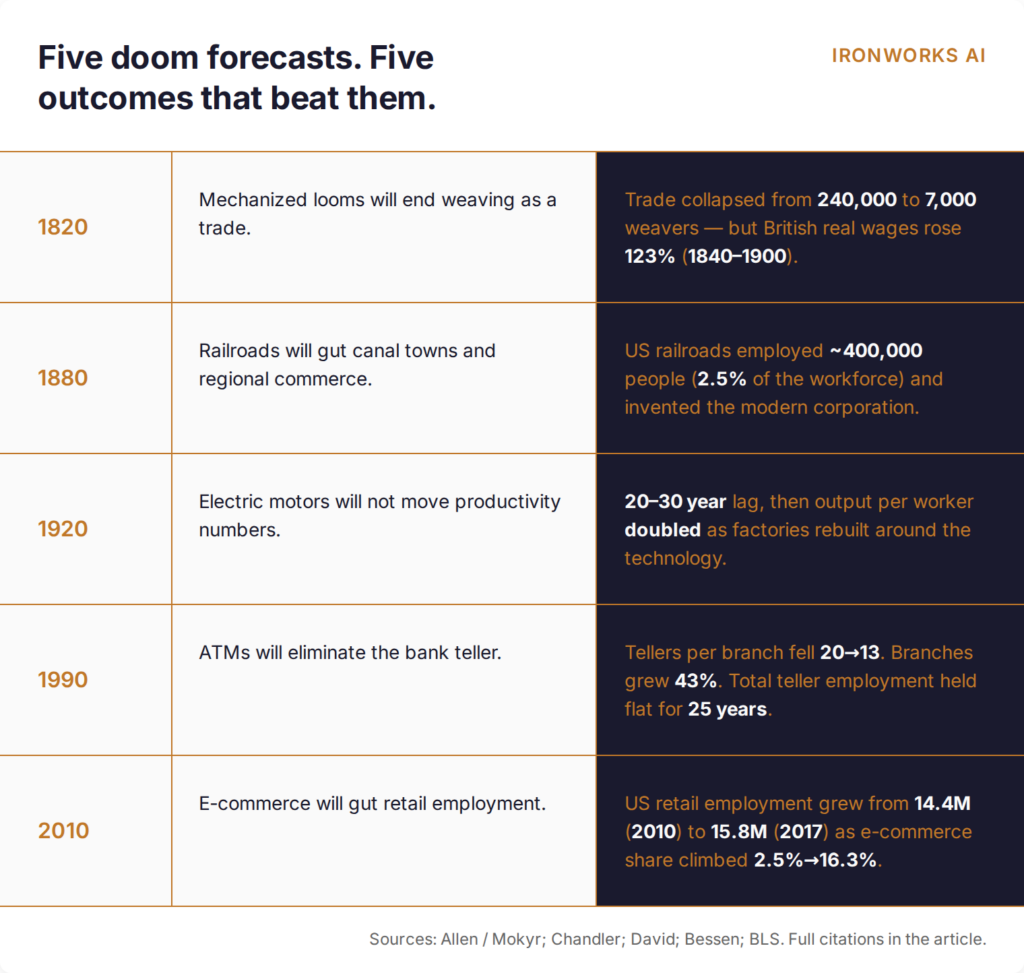
In 1811, English handloom weavers started smashing the new mechanized looms. They were called Luddites. They were not stupid — they had read the situation correctly at the level of their own jobs. Handloom weaving had grown from about 75,000 workers in 1795 to roughly 240,000 by 1820. Then it collapsed to 7,000 by 1861. The trade was annihilated. (Allen, “Engels’ Pause”)
This is the part the optimists usually skip: it took a long time for the win to show up. From 1790 to 1840, fifty years, British per-capita GDP rose 46% while working-class wages rose only 12%. Economic historians call it Engels’ pause. The technology was real, the productivity was real, but the wages didn’t move for two generations of workers. If you were a handloom weaver in 1825 and someone told you to wait it out, you would have laughed in their face.
But then it broke open. Between 1840 and 1900, British real wages rose 123%. Output per worker rose 90%. The same economy that had ground a craft into dust produced the largest sustained wage gains in human history up to that point. (Allen / Mokyr)
The honest version of the story: the handloom weaver was the call-center rep of 1820. Their job vanished. The British economy did not.
Railroads through electrification
The railroad doomers had the same script. Canal operators, teamsters, innkeepers along the old turnpikes — they all warned that rail would gut regional economies. Some of them were right about themselves and wrong about everything else. By 1880, US railroads employed roughly 400,000 people, about 2.5% of the entire American workforce. The Pennsylvania Railroad alone had 50,000 employees at a time when most textile firms had fewer than 2,000.
Rail also gave us the modern corporation. Alfred Chandler’s The Visible Hand argues that the railroads invented the multi-divisional company structure we still use 150 years later. The technology that “killed jobs” created the org chart.
Then came electricity, and the most useful piece of economic history for understanding AI right now. In 1900, electric dynamos were everywhere — but they hadn’t shown up in the productivity statistics. Stanford economist Paul David figured out why. Productivity gains lagged 20 to 30 years behind the technology because factories had to be physically rebuilt. The old layout had a single steam shaft running overhead with belts dropping down to each machine. The new layout needed distributed motors at every station, which meant new floor plans, new workflows, new management. The motors worked fine; the workflows around them had to be rebuilt.
That’s where most SMBs are with AI right now. You tried ChatGPT. Your P&L looks the same. The technology works fine — the workflows around it haven’t been redesigned yet. Then Ford did exactly that — cut Model T assembly from 728 minutes to 93, and on January 5, 1914, doubled wages to $5 a day because the new system needed workers who could afford the cars they were building.
The ATM paradox
This is the section to remember. If you read nothing else in this piece, read this.
ATMs hit American banking hard in the 1980s. Every analyst, every business-school case, every newspaper said the same thing: bank tellers were finished. Why pay a person to dispense cash when a machine does it 24/7?
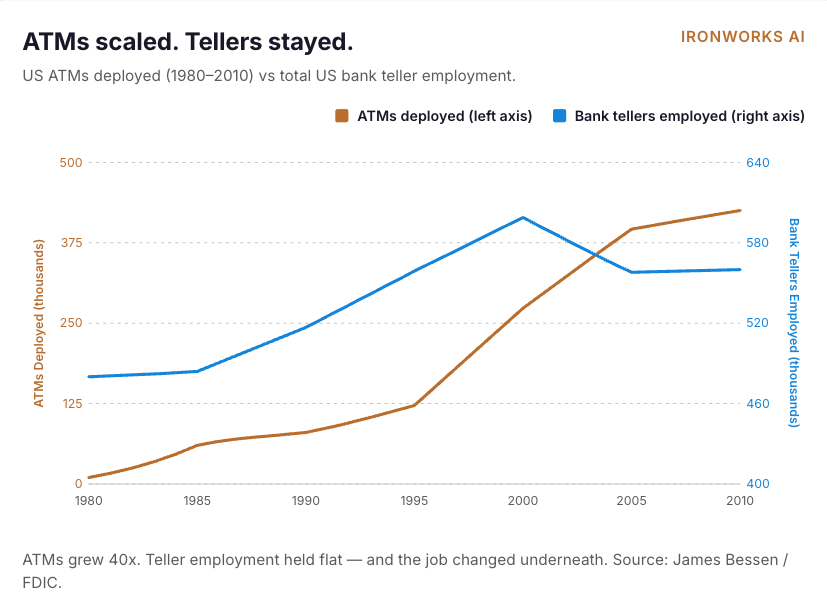
Then the actual numbers came in. Boston University economist James Bessen ran them. Between 1988 and 2004, the average urban bank cut tellers per branch from 20 down to 13. Sounds like a wipeout. Except urban bank branches grew 43% in the same window — because cheaper-to-staff branches let banks expand and compete for share. Total US bank teller employment held steady, and in some years grew slightly, even as ATMs scaled past 400,000 machines nationwide.
The headcount stayed flat. The job changed. Tellers stopped counting cash and started doing relationship banking, cross-selling, customer service — work the machine couldn’t do. The technology automated the part of the job nobody actually liked, and the part of the job that mattered got bigger.
The full story has a second act. In the 2010s, smartphone banking (not ATMs) finally started pulling teller employment down. The headline lesson stands anyway: a 25-year window where a technology everyone said would kill an entire job category instead changed what that job was. That’s the realistic case for AI in 2026: a long, useful reshape with real costs along the way.
The internet: the most recent rehearsal
In 1999, every futurist with a column predicted the internet would gut retail. Pets.com, Webvan, “the death of the mall.” Hal Varian, Berkeley economist and later Google’s chief economist, noted at the time that the internet’s real effect would be opening up long-tail markets, meaning more transactions, not fewer.
Twenty-five years later: US retail employment hit a trough of 14.4M in 2010 and rose to a peak of 15.8M by 2017, even as e-commerce share rose from 2.5% in the mid-1990s to 16.3% by Q2 2025. Couriers, warehousing, and storage added 300,000 jobs in 2019-2020 alone. The Kauffman Foundation showed that from 1977 to 2005, new firms (under one year old) added 3 million jobs per year on net while existing firms were net job destroyers most years.
Be honest about the wrinkle: BLS now projects retail trade to lose 1.2% of jobs from 2024 to 2034. So the internet wasn’t a clean win for every sector. The displacement is real. The aggregate is positive. Both things stay true.
One important distinction: this is about business, not bedtime
Everything we’ve written is about the economic and business uses of AI. There is a separate, serious conversation happening about consumer chatbots used outside their intended purpose — particularly when teens use them as substitute therapists or companions. The NPR coverage of multiple Character.AI lawsuits, and the Sewell Setzer III case settled by Character.AI and Google in January 2026, point to documented harm when consumer chatbots operate without mental-health guardrails.
That conversation is real. It deserves regulation, and the lawsuits are doing useful work pushing for it. But it has nothing to do with whether your bookkeeper should use AI to reconcile your AR aging report, or whether your dispatcher should use it to triage service calls. Conflating economic AI tools with unregulated companion bots is how panic gets manufactured. Two different products, two different harms, two different debates.
The AI-positive case for SMBs
Here’s where it lands for a 30-person Virginia business.
Census Business Trends data shows about 18% of US firms used AI at the end of 2025, with over 20% expecting to in the first half of 2026. In Virginia specifically, the Chamber Foundation found that more than 80% of surveyed organizations are using or considering AI — but only one in four say AI training resources are accessible in their region. The demand is enormous. The supply is thin. That gap is where Virginia SMBs can win.
The numbers SMBs should actually care about come from Salesforce’s 2025 SMB survey: 5.6 hours per employee per week in time savings on average. Managers save 7.2 hours, individual contributors 3.4. 87% of SMBs using AI say it helps them scale, 86% see improved margins, 70% report improved efficiency.
For a 30-person company, 5.6 hours per employee is 168 hours of recovered time per week. At a $40 blended hourly cost, that’s $11,650 per employee per year, or roughly $350,000 across the company. The equivalent of four full-time hires you don’t have to make, redirected from busywork to the work that produces revenue.
That’s the actual SMB story. A 30-person company with the right tooling can punch like a 50-person company without the headcount, the benefits load, or the management overhead. The historical pattern says the businesses that redesign the work around the technology — not the ones that bolt it on — capture the gains. Bessen’s tellers stopped counting cash and started selling. Ford’s workers stopped hand-assembling and started running a line. In both cases the job got more valuable as the busywork fell away.
The Engels’ pause is a real warning. Individual displacement hurts even when the aggregate works out. The 24-year-old whose entry-level marketing role vanished doesn’t care that British real wages rose 123% from 1840 to 1900. We owe those workers honesty, retraining, and roles that use AI as a tool instead of treating it as competition.
But the panic — the 35%-of-jobs-at-risk headline, the doom-loop coverage, the freeze-hiring instinct — runs against every piece of evidence we have from steam, rail, electricity, ATMs, and the internet. Five tech loops, five doom forecasts, five outcomes that beat the forecasts. Maybe the sixth one is different. We’ve been at this long enough to bet it isn’t.