
The most advanced AI operation in Richmond makes ice cream
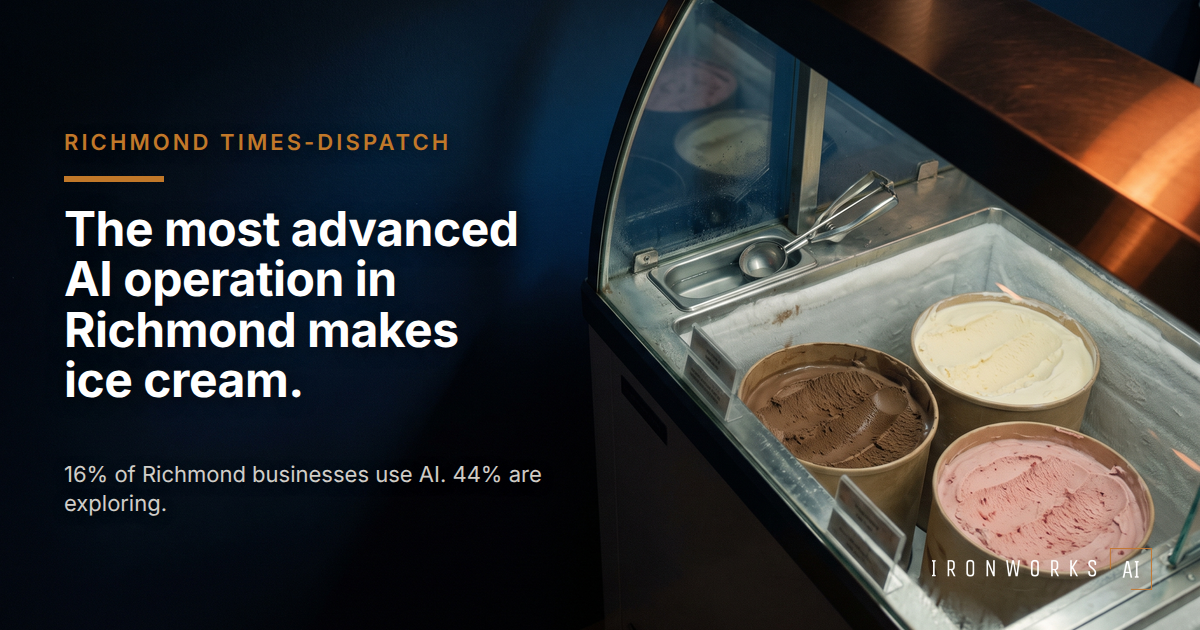
The Richmond Times-Dispatch published a survey of Richmond-area businesses and AI on Sunday (Richmond Times-Dispatch, Aug. 30, 2026). Sixteen percent of the businesses surveyed are actively using AI. Another 44% are exploring it. And the most advanced AI operation in the story, by our read of it, scoops ice cream.
That’s Gelati Celesti.
Their director of finance, Chris Clark, taught himself at night. His first real win was a weekly labor report he automated in about eight hours in one night, and those eight hours landed after roughly two weeks of getting nowhere. He has written more than 150 of his own automations since.
We’ve never worked with Gelati Celesti. We read about them in the paper like everybody else. But the shape of that first win is honestly what we’re all about.
Four things about the shape of it
It never faces a customer. A weekly labor report is interior work. No guest sees it, no order depends on it, and nobody’s cone melts if it runs wrong on a Tuesday. Your cone would melt as we write this, it’s about 96 on a September Wednesday as we write this. Point is though, that is about the safest place a business can start, and it’s where most of the recoverable hours in a small company actually sit.
The person who owned the pain built it. The finance lead who owned that report is the one who automated it. Whoever runs a report every week already knows which columns matter, which exception breaks the file, and what finished looks like. That knowledge is the expensive part of any build, and it comes free with the job.
Two weeks of nothing came first. This is the part most AI stories leave out. Roughly two weeks of failure, then one night where it worked. Anyone who quits in week one concludes the tools don’t work for a business like theirs. They were about eight hours from the opposite conclusion.
One win turned into 150. The second automation costs less than the first, because the first one teaches you the tool. That compounding rarely shows up in anybody’s pitch deck.
The arithmetic on one weekly report
Take an illustration, and treat it as one. It’s a made-up report, and it says nothing about Gelati Celesti’s.
Say a finance lead spends two hours a week assembling a labor report. Pull the punch-clock export, reconcile it against the schedule, fix the two shifts somebody coded wrong, build the summary, send it. Two hours a week runs about 100 hours a year. At a loaded cost of $60 an hour, that’s roughly $6,000 a year, on one report, in a company that probably has a dozen reports like it.
Six thousand dollars rarely changes anybody’s year. Two and a half weeks of a senior person’s time might. That’s the number worth chasing, because a finance lead who gets 100 hours back spends them on the questions only he can answer.
What the 44% are waiting on
Sixteen percent using, 44% exploring, and by subtraction about 40% doing neither. The middle band is the interesting one. Exploring is a real state, and most owners in it are honest about why they’re stuck. The questions come in some version of the same three: is it safe, is it worth it, and who does the work?
An internal automation answers all three at once, and cheaply. Safe, because no customer touches the output and a bad run costs one afternoon. Worth it, because you can count the hours before you start and count them again after. And the work gets done by somebody already on payroll, sitting in the seat where the pain lives.
That’s why “never faces a customer” is the door. Every objection an owner has to AI gets smaller when the blast radius is a spreadsheet nobody outside the building will ever open. Start where a failure is boring.
We say it a lot these days: AI is really fun and exciting; AI adoption is tedious and boring.
Some businesses in the story have decided against AI outright. Those objections are real, we hear them, and we’ll get to the most common objections we hear to AI adoption soon.
A Richmond version of something we keep writing
None of this is new around here. We wrote “You can just install Claude Code tonight” in May, and “You can just decide to be AI-native” a few days later. Both argue that the first move is small, cheap, and available to any owner who decides to make it, and that the six-month evaluation costs more than the experiment does.
The RTD story is the sharpened version of that argument, with a name attached, a company attached, a count of automations attached, and a Richmond address on all of it. We’ve been making the case in the abstract. Clark made it in a spreadsheet.
If you run a small business in this market, there’s meaningful time and money sitting in the automations your customers will never see. You can hire a company like ours to build them. You can also do what Clark did, on a laptop, after close.
A good share of that 16% probably started at two weeks of getting nowhere. Most of the 44% are still in week one.