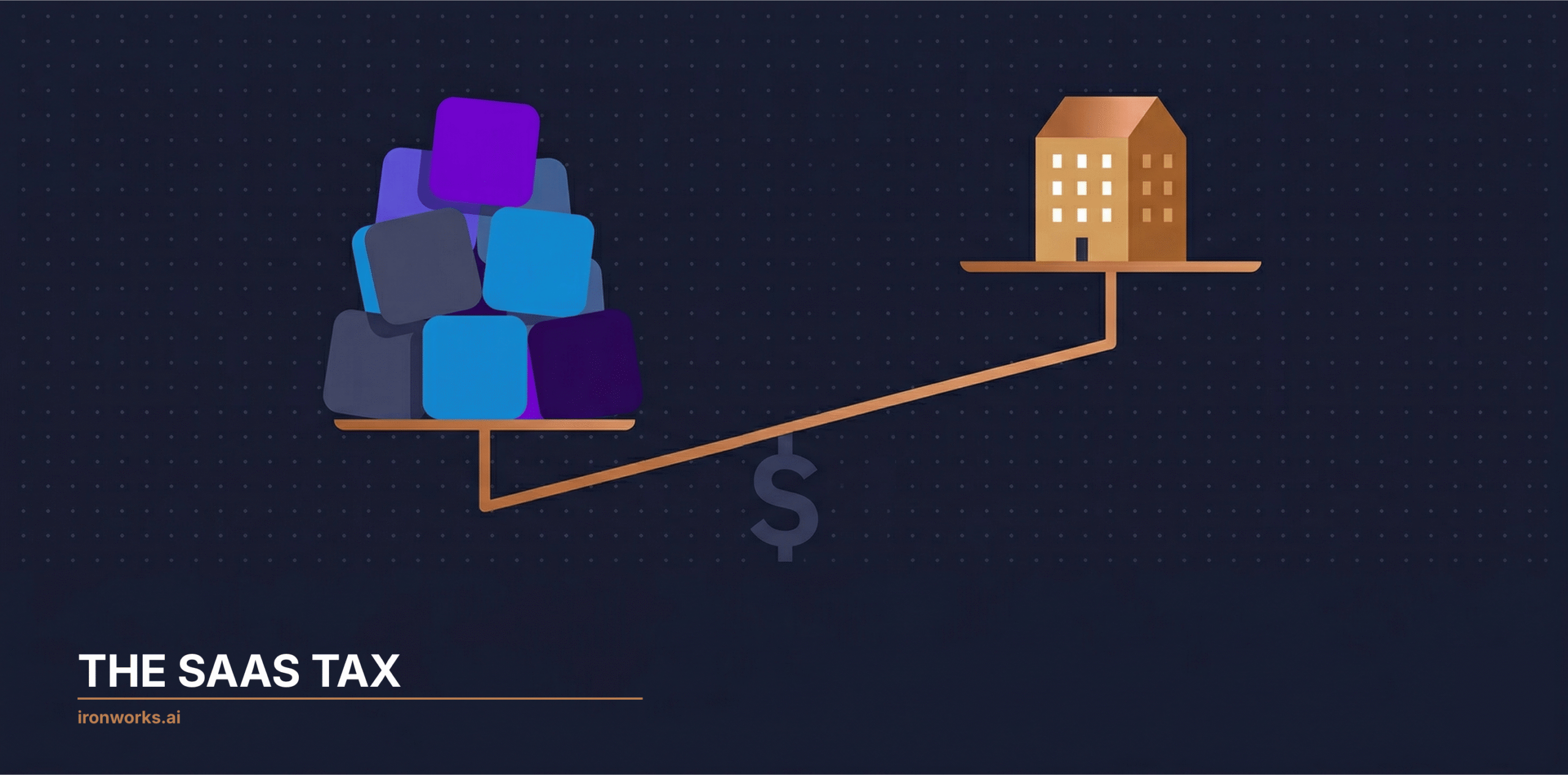
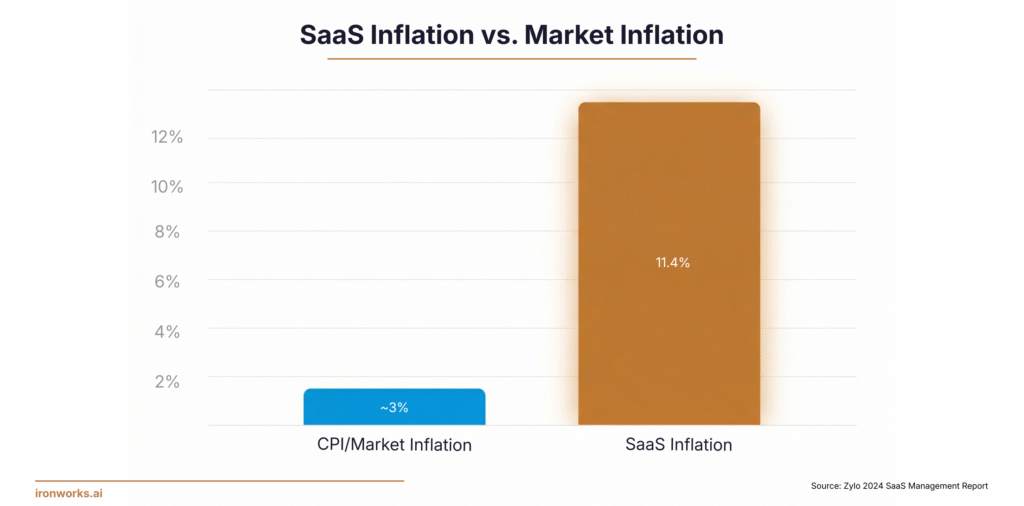
SaaS prices went up 11.4% last year. Your revenue almost certainly did not keep pace. And the vendors raising those prices are calling it “growth.”
I want to talk about that — specifically, about the moment I realized, running my own firm, that our software licenses had quietly become one of our largest operating expenses. Not because we bought anything new. Because every vendor raised prices at the same time.
The Number Nobody Talks About at Board Meetings
Consider a typical 25-person company. According to Vertice’s 2026 SaaS Inflation Index, the average business now spends approximately $9,100 per employee per year on SaaS tools — up from $7,900 just two years ago. That is a 15% increase in a period where general inflation in the US averaged about 2.7%.
For that 25-person company, the math is straightforward: roughly $227,500 a year in software costs, and the bill grew by about $30,000 in two years without adding a single new tool. That is the equivalent of a part-time employee’s salary — gone — and you did not even get a new feature out of it. If you run a 30-person company, the number is closer to $273,000. And it went up roughly $36,000 in the same period.
I know these numbers feel real because I lived them. When I was running a $12M/year firm, our SaaS stack grew annually without us making a single new purchase.
It just happened, quietly, in renewal emails nobody questioned.
You Are Not Their Customer. You Are Their Margin.
Here is the part that should make you angry: according to SaaStr’s 2025 analysis, roughly 72% of SaaS vendor forward growth is now coming from price increases on existing customers, not from acquiring new ones or building better products.
When you look at the gap between total ARR growth (8.7%) and price increases (6.3 percentage points), nearly three-quarters of the “growth” these companies report to Wall Street is coming directly from your renewal invoices. This is not innovation. This is a tax.
And the vendors have gotten creative about collecting it.
Salesforce pushed through a 9% across-the-board increase in 2023, followed by another 6% hike on Enterprise and Unlimited editions in August 2025, each time pointing to new “AI capabilities” most customers never asked for and many never use.
Adobe restructured Creative Cloud into Pro and Standard tiers in 2025 with effective increases of up to 27% — the old All Apps plan at $54.99/month became Creative Cloud Pro at $69.99/month, with generative AI features bundled as the justification.
Microsoft layered Copilot charges ($30/user/month) on top of existing 365 subscriptions, effectively raising the cost of tools people were already paying for. The pattern is the same every time: bundle AI features nobody requested, call it a “platform upgrade,” raise the price, and bet that switching costs are high enough that you will pay rather than migrate.
They are not wrong about that bet. Switching costs are brutal. But the bet only works as long as you believe there is no alternative.
The Hidden Math: What Your SaaS Stack Actually Costs
The subscription price is bad enough, but it is not the whole picture. Industry analysis consistently shows that the sticker price on your SaaS contract is typically 50-65% of the true cost of ownership. The rest hides in places that never show up on a vendor’s pricing page.
**Integration costs.**
Your CRM does not talk to your project management tool, which does not talk to your invoicing system. So somebody on your team — usually your most operationally competent person, the one you can least afford to lose — ends up spending hours every week manually shuttling data between systems.
I have seen this pattern in every growing company I have worked in or around: the best ops person becomes a human API. They just patch problems with the system, instead of solving problems for the customers or generating revenue.
**Training and onboarding.**
Every new tool requires training. Every major update requires retraining. Every new hire needs to learn the stack. This is not free, even if you are doing it informally. The productivity dip during a SaaS rollout is real and measurable, and almost nobody budgets for it.
**Feature bloat you are paying for.**
This one is quiet but expensive. Industry benchmarks suggest the average SMB uses less than 30% of the features in their enterprise-grade SaaS tools. You are paying Salesforce Enterprise pricing because you need the CRM and the reporting. You are not using the other 70-80% of the platform. But you are paying for it, and the price increases that fund those unused features show up on your invoice just the same.
**API and usage overages.** The pricing page says $200 per month. The invoice says $340 because you exceeded the API call limit, or you needed more storage, or you hit the user cap and had to bump to the next tier. According to data compiled in SaaStr’s analysis, 60% of vendors deliberately mask their rising prices, making cost clarity a negotiation sport rather than a given.
Add it all up and that $9,100 per employee per year is probably closer to $14,000-$15,000 in total cost of ownership. For a 30-person company, that is not $273,000 — it is north of $400,000. On software.
Why This Hits Small Businesses Hardest
Enterprise companies have procurement teams, volume discounts, and the leverage to negotiate. When Salesforce raises prices, a Fortune 500 company calls their account rep and negotiates. When Salesforce raises prices on a 30-person company, that company gets an email and a new invoice. SaaS pricing was originally sold as the great equalizer — small businesses get access to the same tools as the big players, just pay per seat. That was true in 2015.
In 2026, it is a different story. The tools have gotten more complex, the pricing has gotten more opaque, and the switching costs have gotten higher. Small businesses are now paying enterprise complexity premiums on tools they use at a fraction of capacity.
According to Zylo’s 2025 SaaS Management Index, 52.7% of SaaS licenses purchased go unused — not underused, unused. More than half the seats many companies pay for have nobody sitting in them, costing organizations an average of $21 million annually in wasted spend.
For small businesses without dedicated SaaS management, the waste rate is likely even higher. That waste compounds every time prices go up.
The SaaS model was supposed to eliminate the capital expenditure problem of on-premise software. And it did. But it replaced it with a different problem: an operating expense that grows faster than your revenue, controlled entirely by someone else’s pricing committee.
What You Can Actually Do About It
I am not going to tell you to cancel all your SaaS subscriptions tomorrow. That is not realistic, and some of these tools genuinely earn their keep.
But here is what I would do if I were running your operations — and I am drawing on what I learned building and running a $12M/year firm, not from theoretical advice.
**Run the audit first.**
Pull every software subscription your company pays for. Every one. Include the ones on someone’s personal credit card that get expensed. Include the free trials that converted. For each tool, answer three questions: How many people actually use it? What percentage of its features do we use? And what would it cost us in labor hours if this tool disappeared tomorrow? You will find tools that fail all three questions. Cancel those today.
**Stack-rank by pain, not by price.**
The most expensive tool is not necessarily the biggest problem. The biggest problem is the one creating the most friction — the one that forces manual workarounds, the one that does not integrate with anything else, the one your team complains about every week. That is your replacement target.
**Ask the replacement question differently.**
Instead of “which SaaS tool should we switch to,” ask “which three tools could be replaced by one thing that actually fits our workflow?” This is the question that changes the math. Replacing one $50/month tool with another $50/month tool does not solve anything. Replacing three tools that cost a combined $6,000/month with a single purpose-built platform that costs $800/month to operate — that is a different equation entirely.
**Negotiate before you renew.**
Eighty-three percent of successful SaaS renewal negotiations start at least 120 days before the renewal date, according to Vertice’s analysis. If you are getting the renewal email and just clicking “pay,” you are leaving money on the table. Call. Ask for the increase to be waived. Ask for a multi-year lock. Ask what the retention team can offer. Vendors would rather discount than churn. But they will never volunteer the discount.
**Budget 2x for any new tool.**
If you are evaluating a new SaaS tool or AI platform, take the subscription price and double it for Year 1 planning. That covers training, integration, productivity dips, and the inevitable overages. If the ROI still works at 2x the sticker price, it is a good investment. If the business case only holds at the listed price, you are taking a gamble.
**Start thinking about custom.**
I will be transparent — I run a company that builds custom AI tools, so factor that into how you weigh this advice. But the math genuinely works for companies that are paying $50K+ per year on SaaS tools that overlap, do not integrate, and require constant manual workarounds.
A custom platform with a $60K-$85K build cost and $8K-$10K annual operating cost pays for itself in 18 months and costs a fraction of the SaaS stack it replaces. More importantly, it fits your workflow instead of forcing your workflow to fit someone else’s product. That is not a pitch — it is arithmetic.
The Tax Is Optional
Here is the thing about the SaaS tax: unlike actual taxes, you do not have to pay it.
The vendors are betting that inertia, switching costs, and the fear of change will keep you writing checks. For most companies, they are right. But the companies that are breaking out of this cycle share a common trait: they stopped asking “which tool should we buy?” and started asking “what does our operation actually need?”
Those are very different questions, and they lead to very different answers.
Your SaaS bill went up 11.4% last year. The question is not whether that number bothers you.
The question is what you are going to do about it before next year’s renewal hits.