
What’s in a name?
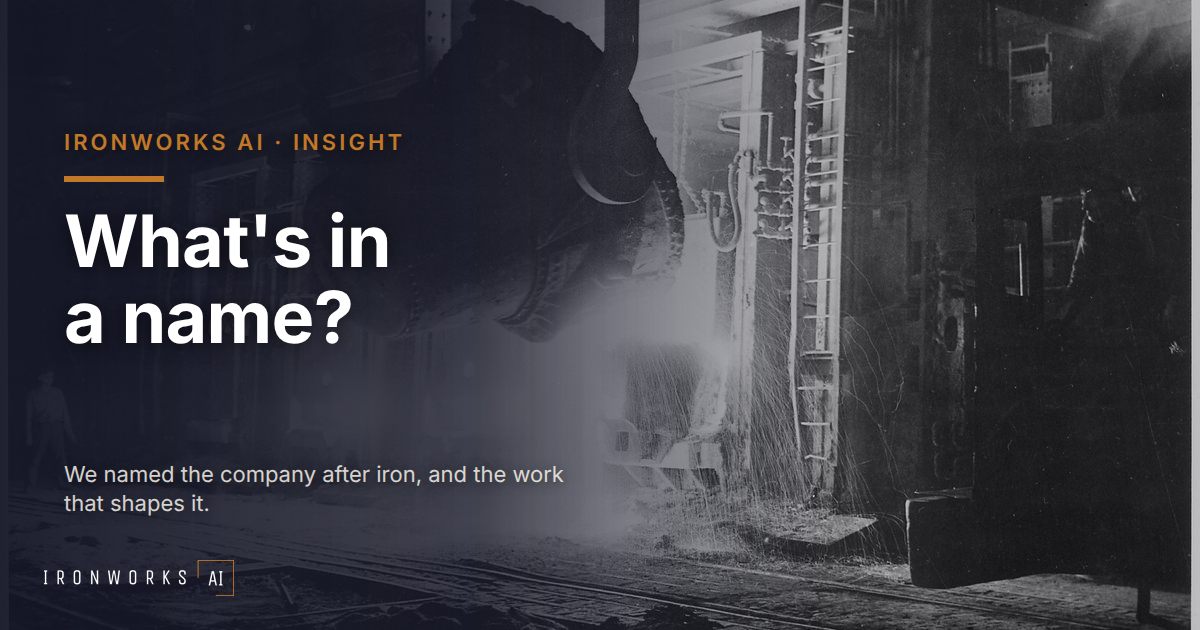
How do you name a company?
That’s a question, we suppose, most people never ask themselves, while others ask it dozens if not hundreds of times. The internet has a term for those people now, serial entrepreneurs.
We found ourselves asking it in late 2025.
The Eleventh Doctor said it well, we think: “the name you choose, it’s like a promise you make.” We wanted ours to commit us to something hard.
We named the company after the hardest, most useful thing a place can make, and after the work that makes it.
Ironworks.
It says everything we believe about building AI for a real business: it should be strong, useful, and forged. And it comes with a deep lineage.
What an ironworks actually is
Humanity has been doing this a long time, forging iron, that is.
The Iron Age started around 1200 BCE, when people first learned to pull iron out of rock and work it into tools that held an edge: plows, axes, nails, blades. Iron built most of civilization. Rails and ships and engines and bridges and the bones of every building taller than a few stories. When you want something to last, you still reach for iron.
An ironworks is two things at once.
It’s a place: the plant where raw iron ore goes in one end and heavy, finished iron and steel come out the other. Furnaces, foundries, forges. Smelting. Casting. The physical site where ore gets turned into rails, beams, and machines. Things that hold weight.
The first ironworks in Europe we’d recognize today was a water-powered blast furnace at Lapphyttan, in Sweden, nearly nine hundred years ago.
Since then, along rivers and across every continent, people have erected ironworks and built their lives and livelihoods out of them.
And it’s the act: the work itself, the doing, the labor inside the building. An ironworks is iron being worked, right now, by people who know what heat does to metal, the shapes and angles to cast, when to cool it, how to handle it, and all of the potential the final product holds.
An ironworks is alive. The process of making, of forging, iron is not gentle. The heat rolls off the furnace in waves, well past a thousand degrees. The blast roars as air is pushed through furnaces larger than most living rooms. Hammers, heavy ones, ring on the anvil in a rhythm you feel in your teeth, and we imagine that’s a much better place to feel it than your fingers. The air smells like scorched foundry coke, the very pure and refined coal needed to raise the blast furnaces to the temperatures required, hot metal, and sweat of men and women working long hours. Everything glows orange, at least everything not turned space black by the dust that hangs in the air. It’s loud, it’s dangerous, and it is unmistakably a place where something is being made.
And for a long stretch, a lot of people made their living that way. American iron and steel employed about 650,000 people at its peak in 1953. Today it’s closer to 83,000. And we make about as much steel as we ever did. The machines just need fewer hands to do it. We mention all this because when we picked the name, we picked the lineage with it. Three thousand years of people putting metal in the fire and beating it into something useful.
That double meaning is the whole reason we liked it. “Ironworks” is a working word. It refuses to sit still. You can’t say it without implying that somebody is making something, working something, building something. The craftsmen of an ironworks are skilled, and operate with precision and power, with a deep understanding of their craft. There’s no version of an ironworks where nothing gets built. At that point, it’s just an expensive building.
We want to embody all of those things too. Hot, roaring, heavy hammers that look and smell like work, building lives and livelihoods with skill, precision, power and a deep understanding of our craft.
Altogether, it felt right for what we strive to do: show up, get our hands on the actual problem, and make something that holds.
Iron plus work, all the way down
All great scholars study their obsession down to its root, so we wanted to understand the word itself.
Enter etymology, or at least a conversation with AI about the etymology of ironworks.
The technical process at an ironworks usually goes by a clinical name: ferrous metallurgy. Accurate, and a little lifeless.
The older word is siderurgy. It comes from Ancient Greek: σίδηρος (sídēros), “iron,” and ἔργον (érgon), “work.” Iron-work.
We loved that. Strip the name down to its root and there’s nothing clever hiding in there. No frills, no abstraction, no consultant gloss. Just iron, and work. Two of the plainest ideas a human being can have, stuck together because the second one is what you do to the first.
A name that’s honest at the etymological level is a good name to live up to.
Richmond has been forging iron since before the country existed
We’re a Virginia company, and Richmond, Virginia especially was iron country from the very beginning. Maybe before the beginning, depending on when you date the country. We’re Virginians, so we date it to Jamestown, and iron production is often (always?) overlooked as one of the seminal events of the red-letter year of 1619.
Falling Creek Ironworks, on Falling Creek where it runs into the James River just south of Richmond, ran from 1619 to 1622. It was the first iron production facility in North America. The first one.
Before there was a United States, before there was much of anything, the first attempt to make iron on this continent happened a few miles from where we sit.
It didn’t last long. But American industry started here, on this river, with iron.
After the Revolution, Richmond grew into an important industrial city in the region and for the country, and the engine was the James River. The fall line, where the river drops over rock in a run of rapids, gave the city its power. The rushing water at the falls, and the James River and Kanawha Canal that harnessed it, drove the mills and the foundries: iron, flour, paper, tobacco.
The landmark of that era was Tredegar Iron Works, founded in 1837 on the bank of the James. By the mid-1800s it was Virginia’s largest iron manufacturer, and by most counts the fourth-largest in the country: a five-acre complex right on the riverbank. It rolled rails and built the locomotives that pushed Virginia’s railroads inland, and the machinery it turned out seeded a whole generation of Richmond business. A lot of what Richmond became, it became because there was an ironworks at the center of town making the things everyone else needed.
The buildings are still there. The old works stand on the James today, preserved as a museum and a National Historic Landmark. You can walk the ground.
The name didn’t leave, either. There’s a publicly traded Tredegar Corporation headquartered in Richmond right now, and the chemical companies that grew into Albemarle and NewMarket trace their address back to Tredegar Street, on that same stretch between the river and the canal. The furnaces went cold a long time ago. The habit of building on that ground never did.
Virginia has a way of making things that outlast the making of them. A Virginian penned the Declaration of Independence, and four of the first five presidents were Virginians, the stretch of leadership that got the young republic on its feet.
We took the name partly as a nod to all of that. To the region that was forging iron before the flag had stars on it. We didn’t invent the metaphor. We inherited the address.
What Ironworks means to us
We build AI tools for small and mid-sized businesses. Here’s what the name asks of us in return.
We build strong things. Strong like iron: useful, durable, things that actually work and actually build something of value for the business that paid for them. A working tool that earns its keep, instead of a slide deck about AI or a pilot program that sits on company-issued laptops for years.
And we believe success is forged in fire. Any SMB owner knows this in their bones, because running a small business is the fire: making payroll, fixing what breaks at 11pm, doing the work when nobody’s watching and nobody’s clapping. The best businesses are built in that heat. So are the best tools. Nothing worth keeping comes out of a cold forge.
Our motto is rooted in the practicality of working iron and metal: you have to work fast, there will be imperfections, and a skilled craftsman is relentless about fixing them.
Build. Break. Fix. Fast.
Build the thing. Break it under pressure yourself, on purpose, before the real world breaks it for you in front of a customer. Fix what failed. And move fast, because the iron won’t stay hot forever. There’s a window where the metal is soft enough to shape, and good operators don’t waste it. Everything we care about lives in those four words.
That’s the name. A place, an act, a root word, a lineage and history, and a promise to make things that last, things of value. 96% of small businesses say they plan to adopt AI; only about one in five actually have. The gap between saying and making is exactly the gap Ironworks AI exists to close. Somebody has to do the work on the iron.