
Don’t Let AI Become Your New Tupperware
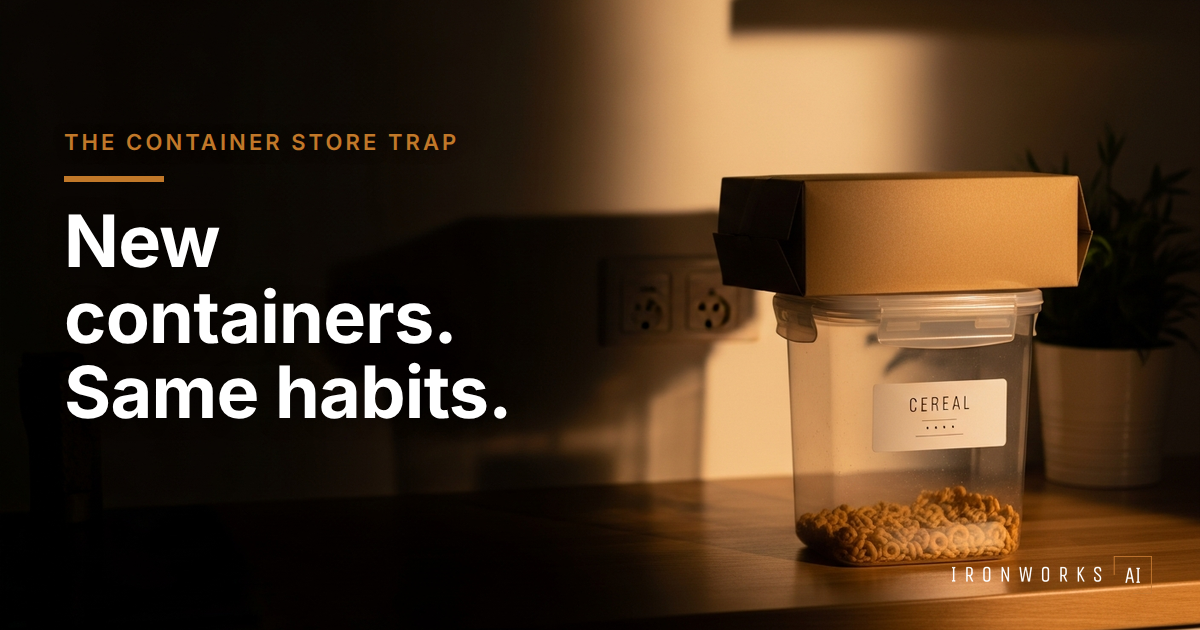
You know this kitchen. The oatmeal you eat every morning lives behind a bottle of white wine vinegar that expired in April. There’s a moldy heel of bread under a bag of stale chips, under the fresh unopened bag you Instacarted yesterday. The frying pan you need right now is pinned under a lid that doesn’t match anything you own. The kids’ lunchboxes are stashed behind the air fryer for reasons no one remembers.
So one gorgeous fall Saturday, you and your spouse skip College GameDay and the pumpkin patch and drive to the Container Store. You come home four figures lighter — Pyrex, Elfa, OXO Good Grips, a label maker off Amazon, sliding shelves from Home Depot arriving Tuesday. The cereal goes in a clear bin with a printed label that says CEREAL. There’s a container for the containers. Every lid latches. Every lid has a match.
Then the ceremony. You walk each kid through the new system: snacks live here now, lunchboxes go there, Mom and Dad refill this bin every morning so it’s always full. Costco runs change too — everything comes out of the flat and into a labeled container before it hits a shelf.
This is the new system. This is the new process.
Here’s what wasn’t on the receipt: new discipline.
Six weeks later, the cereal box is sitting on top of the empty cereal container, which holds three stale crumbs from the last time anyone refilled it. Half the lids are orphans again. The frying pan is stuck under a bin, and the bin is gone when you actually want it. You bought a beautiful system and kept your old habits. The habits won.
Don’t do this with AI.
The Container Store version of AI
Right now every SMB owner is standing in the Container Store version of AI. Copilot seats. A ChatGPT Team subscription. Three “agents.” A vector database somebody set up. A Slack bot that summarizes the channel nobody reads. It photographs well. It feels like progress. And most of it ends up exactly where the cereal container ended up.
The numbers are brutal here. A widely-cited MIT report on corporate generative-AI rollouts in 2025 found that about 95% of them never moved a real business number: no hours back, no dollars saved, no revenue added. The models work fine. GPT and Claude do their job. The failure is human. People bought the containers and skipped the discipline.
The discipline was never the containers
Think about what the discipline actually was in the kitchen. Not the bins. The rule that the empty container goes in the dishwasher, not on the counter. The rule that you refill before it hits zero. The rule that the lid goes back on the body it belongs to, every time, by everyone, even at 6 a.m. when you’re late for the bus. The containers only pay off when the behavior around them changes and holds.
AI is the same. A tool that drafts your proposals is worth nothing if your team writes them the old way by week three because the actual workflow never changed. An agent that reconciles invoices saves you zero hours if the controller keeps doing it by hand, because she never trusted the handoff and nobody built the check that would earn her trust. The subscription renews. The behavior reverts. Now you’re paying four figures a month for labeled bins full of stale crumbs.
The three questions before you buy another seat
So here’s the operator version. Before you buy another seat, answer three questions.
- Who changes their daily behavior because this thing exists, and what exactly do they do differently?
- What catches the backslide the first week someone is tempted to fall back to the old way?
- How do you know it worked — which number moves, by how much, by when?
If you can’t answer those three, a new AI seat just buys you nicer bins. The stale crumbs come standard.
We’ve said a version of this before, when Mark Cuban put it in four words: old habits, new tool, same result. The Container Store is the kitchen-table proof. Change the behavior and the tools finally earn their keep. Leave the behavior alone and you get a cereal box sitting on an empty cereal bin.
We build the discipline that makes the containers work. That’s the whole job. The frying pan should be where you reach for it. Every time. By everyone. Even at 6 a.m.